As any of you who know me will realise, the "Making it in Mandurah" words on the right of this blog are somewhat tongue in cheek. For many people around these parts "Making it" seems to mean holidaying in Bali and owning a huge house, a huge vehicle, his 'n' hers jetskis plus and various other things I am not the slightest bit interested in.
My version of "making it" is considerably more modest and involves having time to, well, make things including our vegetable garden and good meals. I am happy to report that in gardening terms, we have recently met a couple of criteria I set myself and have officially made it.
Late autumn and early winter are great times in the garden here as the temperature stays in the twenties or below and it rains fairly frequently and heavily. This means that we have finally got to the point where our garden is providing most of the vegetables we eat. Given that we started with a sand dune this is no mean feat. Every morning I head out into the garden with my colander to pick salad greens for our packed lunches. Every evening I head back out there to harvest more food for our evening meal.
I have been repeating that pattern over
and over
and over again
for several weeks now. The big winners have been kale, chinese stirfry greens, chillies, beans, rocket, mizuna, herbs and pumpkins.
But I set myself another criteria when it comes to "making it" in the garden. Our garden must also be a great and safe place for local wildlife to live in and visit. I've been on a couple of courses about creating wildlife-friendly gardens (thank you City of Mandurah) and read about how various chemicals can be problematic for wildlife so we've given them all a big swerve.
We have succeeded in attracting numerous birds to the garden and we now also have masses of lizards. There is one creature I am not too excited about. Here is a calling card it left us in the shed.
Yes that is a (tiny) snake's shed skin. Our planned frog pond is still just a concept but frogs have moved in anyway. In the evenings we hear a chorus of burrowing frogs in the front garden (put put put) and here is a motorbike frog who has recently shifted into the back garden (vroom vroom vroom).
I woke in the night with a raging temperature to hear a Boobook owl right outside the window (bookbook bookbook bookbook) and today I'm just admiring our garden from the great indoors (and mucking around creating repeating patterns) as I have woken up with a lurgy. I've swapped my work day for tomorrow and was still in bed reading when I heard a squeeeak in the driveway then the cheery hellooo of a friend who had popped by while out doing chores. She's never popped in unannounced before and was a little apologetic about doing so. I however was delighted and would have loved to have said "coffee?" and welcomed her in despite the fact that my house is messy and I am wearing PJs and have bedhair like a crazy chicken, but we thought it best that I don't share my germs.
It is three years today since we left New Zealand. I still dearly miss my NZ friends especially my closest "swing-by" friends. The fact that I finally have a swing-by friend here means that I really am making it, at least by my definition.
There is one striking plant around these plants that I never tire of looking at and was keen to plant in our garden. The distinctive Xanthorrhoea preissii or Australian Grass Trees are called Balga in the local indigenous Nyungar language (sometimes also spelt Noongar, Nyoongar, Nyoongah, Nyungah, or Noonga) and are common in bushland here as well as in gardens and public plantings.
The one above is in a front garden in Dawesville, the ones flowering below are in bushland near Dunsborough,
and here are some spotted alonside the Bibbulmun Track near Dwellingup.
I've seen Balga trees set alight as part of Nyungar "Welcome to Country" ceremonies and I know of gardeners who either trim or set their tall Balga trees alight every few years to keep the accumulation of thatch down. They can survive all but the fiercest of bushfires like this trouper near the town of Harvey.
We know a local artist who collects the resin from the trunks of burnt trees, crushes it then mixes it with solvent to create an amber lacquer (complete with impurities) which she then pours and paints onto canvases.
Balga trees are very slow-growing and very long-lived (up to 600 years) so when land is cleared for housing developments they are often salvaged and sold. The success rate for transplanted trees is apparently quite low unless a huge chunk of soil is taken with them, which of course makes the whole process very expensive. Even the ones that do eventually thrive can go through a startling Ugly Duckling phase while settling in.
I had already decided that much as I wanted one of these trees in our garden, I couldn't be bothered with the expense and hassle of a transplanted one. Then I was given some Balga seeds. I sowed them recently and now I no longer need to covet the beautiful Balga in other people's gardens as I am the proud owner of 36 trees of my own.
After reading one of our plant books I did some calculations. I discovered that a) when I am 85 I'll have to make a decision about trimming, burning or just leaving the build-up of thatch, and b) when I am 135 those trees and I will be about the same height.
One thing that punches well above its weight in terms of the pleasure it brings us is our garden. The irony of this is that gardening at our rental house was as far from pleasurable as you could imagine, in fact it was the absolute bane of my life.
But there is gardening (daft) and there is gardening (not so daft). We chose the latter.
We never intended to buy a house when we moved to Mandurah. We intended to rent long-term. But I hadn't counted on our and all other rental agreements containing something that I had great difficulty doing. I can do many things and I love learning to do new things, but I am absolutely rubbish at having to do things that I consider wasteful, ridiculous or environmentally unsound. So what was the thing that my rental agreement said I had to do and that convinced me to buy a house? Water lawn.
Here is a bit more information to put that in perspective. The Southwest corner of Western Australia has major water issues. It is often described at one of the fastest drying if not the fastest drying region on the planet. Speedy, ongoing population growth is putting existing water supply sources under extreme pressure. It barely rains here for about 6 months of the year so water is stored in dams, sourced from natural underground water reservoirs or produced from desalination plants. The Water Corporation spends a lot of time, money and effort explaining the latest water shortage dramas and imploring people to use water wisely.
But it looks to me like the poor old Water Corp is pushing manure uphill. Walk down any suburban street at almost any time of the day and night here and you will see shockingly wasteful use of water. The custom of growing and watering gardens that are completely unsuited to this climate is widespread and ingrained. People here habitually pour copious amounts of water onto even the most unkempt of gardens and the skankiest of lawns. According to Water Corp information, 44% of residential water use here is used outdoors. And given that 71% of water use is residential, my casual observations of what is happening in my neighbourhood tell me that the potential savings are enormous.
And the lawn here isn't even nice or usable. I won't go into detail but push all thoughts of lush green stuff from your mind. Push away too any thoughts of me mowing lawn with a well-maintained antique push-mower while dressed in a floral sun frock and a wide-brimmed hat. Nothing could be further from the harsh reality of lawn (and gardening in general) in this part of the world. The unfamiliar local combo of searing heat/relentless merciless sunshine/flies/mosquitoes/soils of pure sand meant that we had to relearn how to garden.
But advice on how to garden for these conditions was easy to find. My partner and I attended excellent free gardening seminars put on by the Great Gardens team and I went to various council seminars on creating wildlife-friendly gardens.
So here is what we did. Despite being mostly lawn, our large (980sq m) new property was well framed by existing shrubs and trees. Some of these are inside the perimeter of our property and some hang over the fences from the neighbours. Below are a few of them.
And a few more.
Ahhh. I've said it before and I'll say it again, Australian plants and Western Australian ones in particular are gorgeous.
Not all the existing plantings are exactly to my taste but they do provide some lovely, long, uninterrupted views to far distant mature trees. My photos don't do the view below justice but that particular one always reminds me of a gloriously blousy Karl Maughan painting. It has pink Oleander in front, then blue Plumbago, back to a yellow wattle at the back of our property, peeps of the neighbour's orange and crimson Frangipani, right back to borrowed views of huge distant flowering Jarrah, Karri and Marri trees.
The very first thing we did was create a summer herb patch. Here in the land of scorchio summers plants go bitter when they get heat-stroke, regardless of how much water is poured onto them. We needed the coolest possible position so used the narrow strip down the side of the house. A mere fortnight later that patch was producing. We have had so much Basil for the past 6 months that I am reminded of another Fast Show character: "This week I 'ave been mostly eating ... Basil".
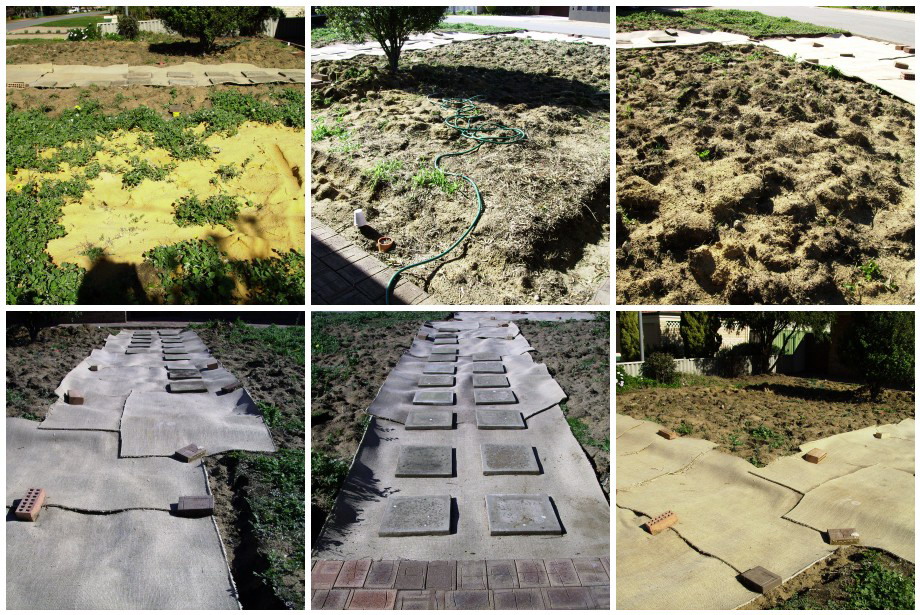
But the biggest job to tackle was the enormous lawned front garden. The process was pretty ugly - yes that is the old wool carpet used as weed matting under the paths.
But then one day three gigantic and gloriously fragrant truckloads of eucalyptus mulch arrived on our front lawn - for free. When I expressed my surprise and delight that such wonderful stuff could be mine for free, the tree-surgeon-dude said "If it's any help to you, we drink Corona." I was more than happy to oblige.
Here is what our front garden looks like now.
Despite planting our garden at the wrong time of the year, everything is doing brilliantly. We haven't used our reticulated watering system once; we carefully hand watered our plants and our water bills are tiny and below half the average for our area. Given that our plants will be well established by next summer, our use will be even lower then. And our garden certainly wasn't expensive. All up we spent less than $300 on landscaping supplies and plants.
The paths and funny little birdbaths were cobbled together from bits and pieces strewn around the property. One of my favourite places to sit with a cup of coffee is on our bed as it overlooks the birdbaths. In the time it takes me to down my long black, up to eight different species of native birds will swing by. (I have tried and tried to photograph them but photographing birds is definitely on my "Stuff I'm rubbish at" list.)
Now it is autumn (woohoo) and a great time for tackling the enormous back garden, which we simply weed-matted with all the stinky curtains then topped with mulch. We won't plant anything permanent there as we plan to eventually build over that area. Tempted as I am to put in some high maintenance topiary dolphins, (obviously not my photo. It arrived in my inbox with a bunch of other nutso topiary creations) the heat/sun/flies/mosquitoes combo means I'll take a different approach. And it won't be plastic lawn despite that being a very popular option here - don't get me started...

Some turkey has been ransacking our tomatoes. Every morning when the children head outdoors hoping to return with ripe juicy garden bounty for their school lunchboxes, they instead find tomatoey scenes of wanton destruction. Tomatoes big, small, green and red lay pecked and lost to us. "Bad budgies!" we say.
Then we found evidence.
Then we caught the culprit red-clawed.
It wasn't a turkey or a budgie but an Australian Ringneck Parrot or Twenty-Eight as they are commonly called. My wildlife book states that they are "very common" which is true, but I think that with their iridescent green wings, necklace of bright yellow and sapphire-tipped tail that they are uncommonly beautiful.
It merrily balanced on one leg while it held one of my tomatoes in the other and continued to chomp away. It looked at me several times as I crept closer with my camera and let out its shrill call which supposedly sounds like "twenty-eight!" but never does to me.
From the (skankier and skankier) lawn its two pals (a fifty-six) gave the same shrill call as they foraged for seed.
I added "netted garden area" to our extensive house-shopping wish-list but I found it hard to get grumpy as:
a) I am from New Zealand and parrots, in my garden = cool!
b) I have a thing about birds who stand on one leg, and
c) today their call sounded just like "Thanking youuuu! Thanking youuuu!" and I am a sucker for good manners.
Usually I make stuff. Since we've been here I haven't made much apart from dinner and clean laundry piles, even though I have the best sewing room I've had for a decade and no lack of time. A couple of vital ingredients are still missing from the mix but I'm working on getting them sorted. In the meantime I've just realised have made something here that I rather like.
I like growing food and dearly miss having a vegetable garden. I also can't stand putting green waste in the rubbish, but there is no organic waste collection here and no compost bin at this house. The back garden at our rental house consists of a bit of skanky old lawn and a few grim conifers growing in pure sand. Much as I'd love to dig it up and plant something useful, my lease agreement forbids me and I am far too much of a goody-two-shoes to contravene it. (My lease agreement also says that I have to water the huckery garden to keep it green and if I don't then I won't get my bond back. Hmmm. In parched Western Australia, where our precious water is obtained at huge financial and environmental cost, this strikes me as completely bonkers, so I'll conveniently lose my goody-two-shoes over that clause.)
So anyway I mail-ordered a Bokashi bin then spent the equivalent of a fortnight's worth of bagged salad at a garden centre and built a tiny, portable garden. This surprisingly productive patch is small enough to be watered with the clean warm-up water we capture in buckets and jugs placed in showers and sinks. It has already produced enough food to have paid itself off several times over.
So what next on the making front? Well first I'm going to make that coffee, a chapter of my book and that piece of ginger crunch (made by my daughter for her Dad's birthday) disappear, then I'm going to make a posh dinner. And given that I've just received the most beautiful and inspiring care parcel in the post from two amazingly talented makers, I think I finally feel a bit more adventurous making coming on.